










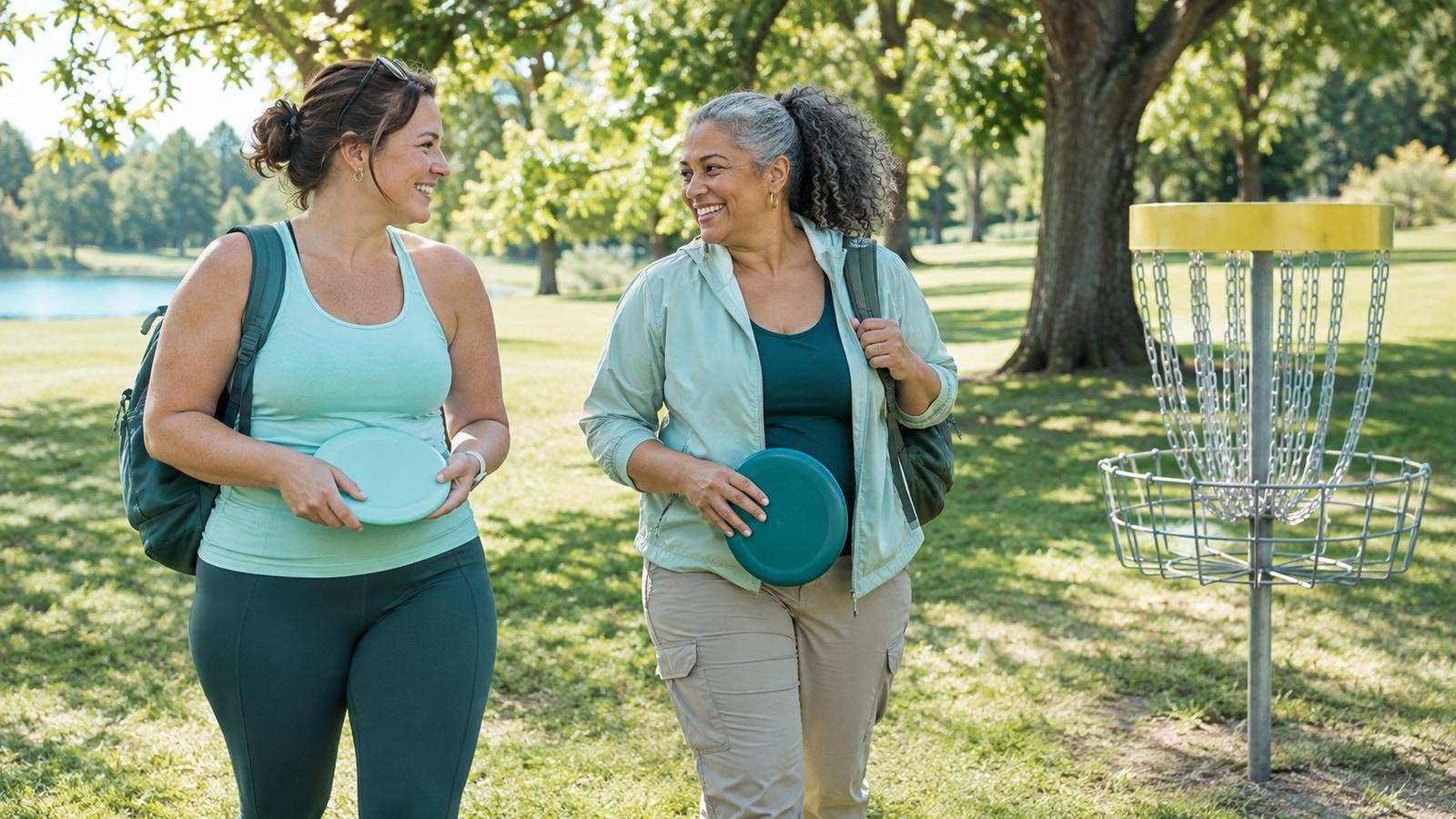
Disc golf gives a walk through a park a small assignment: throw a disc toward a basket, find where it lands, and throw again. You can keep score if you like, but a first outing can be about exploring the course and learning how the disc moves.
You don’t need a bag full of equipment or a powerful throw. A short course, one disc, and a friend who’s happy to take a relaxed pace are a perfectly reasonable start.
What happens on a hole?
Each hole begins at a designated tee area and ends at a target, usually a metal basket with chains. You throw from the tee, then continue from where the disc came to rest until you reach the target. Courses often have nine or eighteen holes, though you can choose to play only a few on a casual visit.
The aim in a scored round is to complete the course in as few throws as possible. On day one, you might instead focus on getting the disc comfortably toward the basket and finding the next tee. A course map or an experienced companion can help, especially when the baskets and paths aren’t obvious.
The discs used for the sport come in different shapes and weights. Ask a local shop, club, or friend for a beginner-friendly disc to borrow or try. One disc is enough to learn the basic idea; you can decide later whether you want to carry more.
Choose the course before you leave
Look for a shorter, beginner-friendly course and check its map if one is available. A course can cover uneven ground, hills, tree roots, or wooded areas. The distance between holes may add to the trip, so consider the whole route rather than only the listed throwing distances.
If you use a wheelchair, rollator, or another mobility aid, ask the park or course organizer about the actual surfaces, slopes, tee areas, and routes between holes. Some locations may offer accessible features or alternative ways to participate, but they vary. A few specific questions are more useful than assuming every park course has the same setup.
Check where you’ll park, whether there are restrooms and places to sit, and what the weather is doing. Wear shoes appropriate for the ground, bring a drink, and let someone know your plans if you’re going somewhere unfamiliar. After rain, a normally firm path may be muddy or slippery.
Put safety ahead of the throw
A flying disc can hurt someone. Before each throw, look ahead and wait until people and animals are clear of the area where the disc could travel. Stay behind the person throwing, and don’t walk toward the basket or another disc while someone else is preparing a throw. If the course shares space with other park users, give them time to pass.
Take a moment to see where your disc lands before moving. If it goes into an unsafe area, you can leave it and ask for help or continue with another disc. A casual round isn’t worth climbing an unstable slope, entering water, or crossing into an area you shouldn’t access.
Give other groups space and follow the course’s posted guidance. When you’re learning, tell a group behind you that you’re new and, when there’s a safe opportunity, let faster players pass. Most of the useful etiquette comes down to awareness and patience.
Start with a gentle throw
Ask someone experienced to demonstrate a comfortable grip and a simple backhand throw. Begin with a small, controlled movement rather than trying to send the disc as far as possible. Notice how it leaves your hand and where it goes. A shorter throw in a direction you intended is a useful start.
You can throw from a stationary position while learning. There’s no need to add a running approach or a large twist to enjoy the game. If shoulder, back, wrist, or knee pain makes throwing uncomfortable, stop and ask a qualified professional for an alternative or advice. A clinician or physical therapist can help if you have an injury or movement restriction.
Try a few throws on one hole, then decide whether you want to continue. A break on a bench or a shorter route back to the car can be part of the plan. If the course is busier or more difficult than expected, you can leave and look for a different one.
Keep the first round low-pressure
If you want to score, count the throws you make on each hole. If you don’t, skip the scorecard and enjoy learning the route. You and a friend can take turns throwing and encourage each other without comparing distances.
Disc golf can be a social way to add outdoor movement to a weight-management routine. How much movement you get depends on the course and your own pace; there’s no need to chase a particular step count. If you take a GLP-1 medication and feel unwell, choose another day and talk with your care team about persistent symptoms or trouble eating and drinking.
Afterward, remember what worked: the length of the course, the terrain, and whether the disc felt comfortable to hold. That’s enough information to make the next outing easier to plan.