










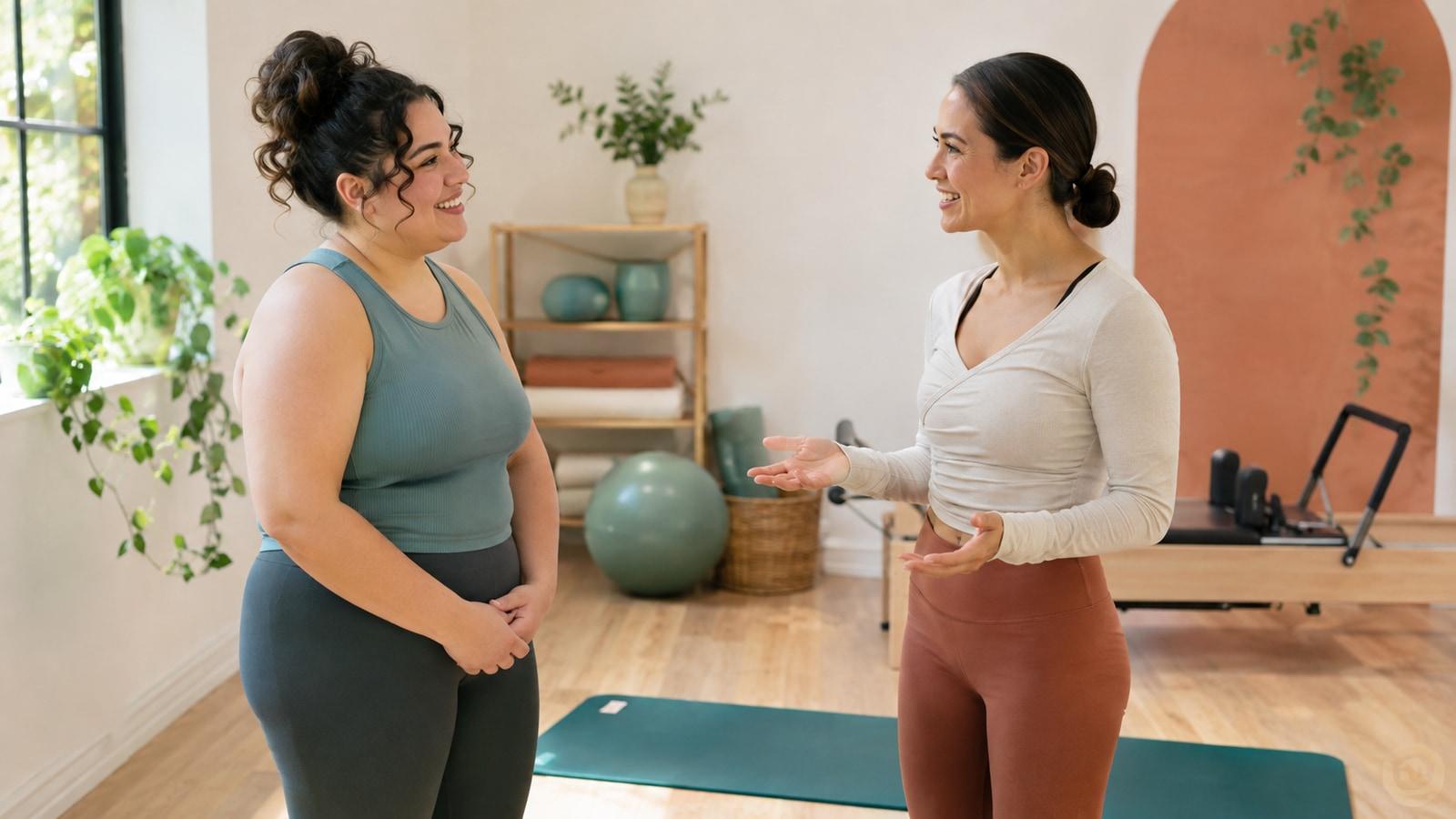
The class description says “beginner Pilates,” but the photos show people balanced on equipment you've never seen. Do you need experience? A certain level of flexibility? Your own mat?
You can ask before you book. Pilates classes vary in format and pace, and a good fit depends less on looking like someone in a photo than on whether the instructor can explain movements and offer options that work for you.
First, what kind of class is it?
Pilates is a form of exercise that can involve controlled movements and attention to strength, balance, posture, and flexibility. Some classes take place mostly on a mat. Others use equipment such as a reformer, which has a moving carriage and springs that provide resistance.
Mat doesn't necessarily mean easy, and equipment doesn't necessarily mean advanced. A beginner mat class may still include getting up and down from the floor. A beginner reformer session may spend time teaching you how to get on and off the equipment and adjust it. Ask what the specific class includes.
If a floor-based class won't work for you, say so when you call. Some instructors offer chair-based or other adapted sessions; availability varies. The useful question is whether they can meet your needs, not whether the class is labeled “for everyone.”
Ask about the instructor's approach
You don't need to know all the exercise names. Try asking:
- “Is this class appropriate if I've never done Pilates?”
- “How do you introduce the equipment or movements?”
- “Can you offer another option if I can't comfortably do something?”
- “Will I need to get onto the floor, or are there alternatives?”
- “Can I observe or try one session before buying a package?”
Tell the instructor about a movement concern you're comfortable sharing—for example, that kneeling is uncomfortable, you have difficulty getting down to a mat, or you need visual instructions. They don't need a full medical history to explain the class. If you have a health condition, injury, recent surgery, or other concern about exercise, ask your health professional what guidance applies to you.
An instructor can teach and adapt exercises within their training, but they shouldn't diagnose a symptom or ask you to ignore instructions from your care team.
Get to know the reformer before it moves
A reformer's padded platform, called the carriage, slides along a frame. Springs create resistance, and a class may also use straps or a bar. You don't need to learn the settings from a photo. Ask the instructor to show you the parts used in your session and explain how they'll help you get on and off.
Spring settings aren't a contest. Ask the instructor to choose and adjust them for the exercise, and tell them if the movement feels too difficult or unstable. Don't change a setting just because the person beside you uses a different one. The equipment and the way a class uses it vary.
If you need a step-free entrance, room for a mobility aid, or help hearing or seeing demonstrations, ask about those details before booking. A single introductory session can also help you decide whether the equipment and teaching style suit you before buying a package.
On the day, arrive with time to settle in
Let the instructor know you're new and ask where you can best see the demonstrations. If the class uses a reformer, ask for an orientation before the session begins. Learn how to approach and leave the equipment, and let the instructor adjust springs or settings unless you've been shown how to do so safely.
During class, focus on understanding the movement rather than copying its largest version. It's fine to use a smaller range, pause, or ask for another option. You do not have to hold your breath to make a movement count; ask the instructor for breathing cues that make sense to you.
If a movement causes pain, dizziness, or makes you feel unwell, stop and tell the instructor. Seek appropriate medical advice for a new or concerning symptom. A little uncertainty while learning a movement is different from feeling pressured to push through pain.
Ask what an unfamiliar cue means
An instructor may use a phrase such as “engage your core” or “find a neutral position.” Those words aren't helpful if you don't know what action they are asking for. Try, “Can you show me what you mean?” or “Where should I feel the effort?” A demonstration or another description may make more sense than repeating the phrase louder.
If the instructor offers a hands-on adjustment, you can ask what they intend to do and say whether you're comfortable with touch. You can also request verbal guidance. Learning how a movement feels in your own body takes time; the first attempt doesn't have to look polished.
Pilates is a movement practice, not a promise to create a specific waistline or “long, lean” muscles. Consider whether you enjoy the class and whether its approach fits the activities you want to do.
Decide whether to go back
Afterward, ask yourself: Could I follow the instructions? Were the alternatives useful? Did I feel respected? Can I see this fitting my schedule and budget?
You might enjoy it immediately, want another session to get familiar, or decide it isn't for you. All three are useful answers. The best class is one you can participate in comfortably and would like to return to—not the one with the most impressive photos.