










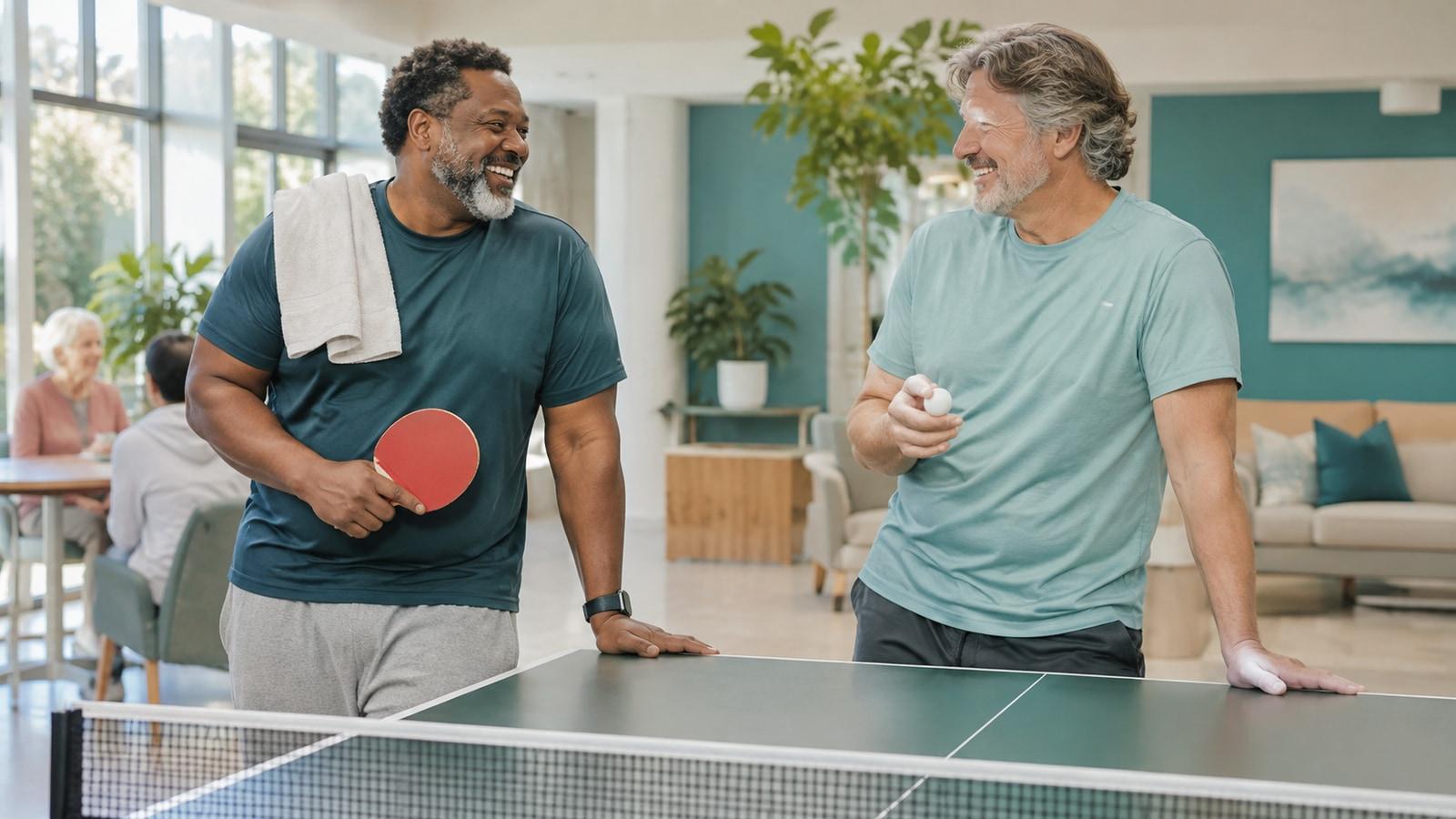
You don’t need a tournament serve or lightning-fast reflexes to enjoy table tennis. A table, a lightweight ball, two paddles, and someone willing to keep the first few rallies relaxed are enough to begin.
Also called ping-pong, the game can be played socially or competitively. For a first session, forget the spectacular shots you’ve seen online. The satisfying part can be as simple as returning the ball once more than you did a few minutes ago.
Find a table and a comfortable space
Community centers, recreation programs, and clubs may have tables and paddles available to borrow. Ask whether there’s a beginner session or a quiet time when you can practice. If you’re playing at home, make sure the table is stable and there’s enough clear space around it. Pick up loose balls between rallies so they don’t become a slipping hazard.
If you use a wheelchair or another mobility aid, ask about the route to the table, space around it, and how the program supports different ways of playing. You may want room to approach and turn comfortably, or a partner willing to keep the ball within a smaller area while you learn.
Wear comfortable clothing and footwear suited to the surface. There’s no need to buy an expensive paddle for a first visit. A borrowed or basic paddle lets you find out whether you enjoy the game before you decide what equipment matters to you.
Get a feel for the paddle
Hold the paddle securely but without clenching your hand. A coach or experienced player can show you a common grip and help you find a comfortable starting position. Before trying to hit hard, practice gently tapping the ball and noticing how much it bounces.
At the table, begin with a partner on the opposite side. Ask them to send the ball slowly toward a spot you can reach. Let it bounce on your side, then guide it back over the net. It’s fine if the first few attempts end up on the floor. Stop, collect the ball, and try again.
You can practice without keeping score. Count how many returns you make together, then see whether you can add one. Because the goal is a shared rally, both players can focus on placing the ball where the other person has a reasonable chance to return it.
Learn the shape of a point
In a rally, let the ball bounce once on your side before returning it over the net. A serve starts the point. In standard play, the server strikes the ball so it bounces on their own side and then the receiver's side; the receiver lets it bounce before returning it. For casual practice, ask your partner or instructor to demonstrate a serve and explain the rules your group uses.
When you’re ready for a scored game, a common format is to play to 11 points and win by two. Players usually switch servers every two points; at 10–10 they switch after each point. You don’t need to memorize every detail on day one. A friendly game can pause while someone explains a serve, a let, or whose turn it is.
Short, controlled strokes are often easier to practice than big swings. You can work on meeting the ball in front of you and returning it gently, then ask a coach about forehand, backhand, or spin when you’re curious. It’s okay to play many enjoyable games before learning advanced techniques.
Give yourself room to move
Even though the table is small, the game can involve quick changes of direction. Start at a pace you can control and agree with your partner to keep the ball within reach. Let a difficult shot go rather than twisting or lunging beyond what feels comfortable.
If you’re playing doubles, communicate about who will take a ball in the middle and keep enough space to avoid collisions. Take breaks between games or whenever you need one. If the room is crowded, wait for a safe moment before retrieving a ball from another table’s area.
Stop if you feel sharp pain, dizziness, chest discomfort, or unusual shortness of breath, and seek appropriate help for severe or persistent symptoms. If you have an injury, balance concern, or movement restriction, ask your care team how to adapt the activity.
Two ways to practice without a match
Try placing a small towel near the center of your partner's side of the table and aiming gentle returns toward it. Your partner can send the ball back to the same spot on your side. Move the target closer if the rallies end too quickly. The point is to notice the angle of the paddle, not to hit hard.
If no partner is available, you can practice bouncing the ball lightly on your paddle in a clear area. Keep the bounces low, stop to collect the ball when needed, and try the other side of the paddle if you're curious. A few minutes gives you a feel for the ball without needing a full game.
Table tennis can add a social element to a weight-management routine without turning the outing into a contest over calories.