










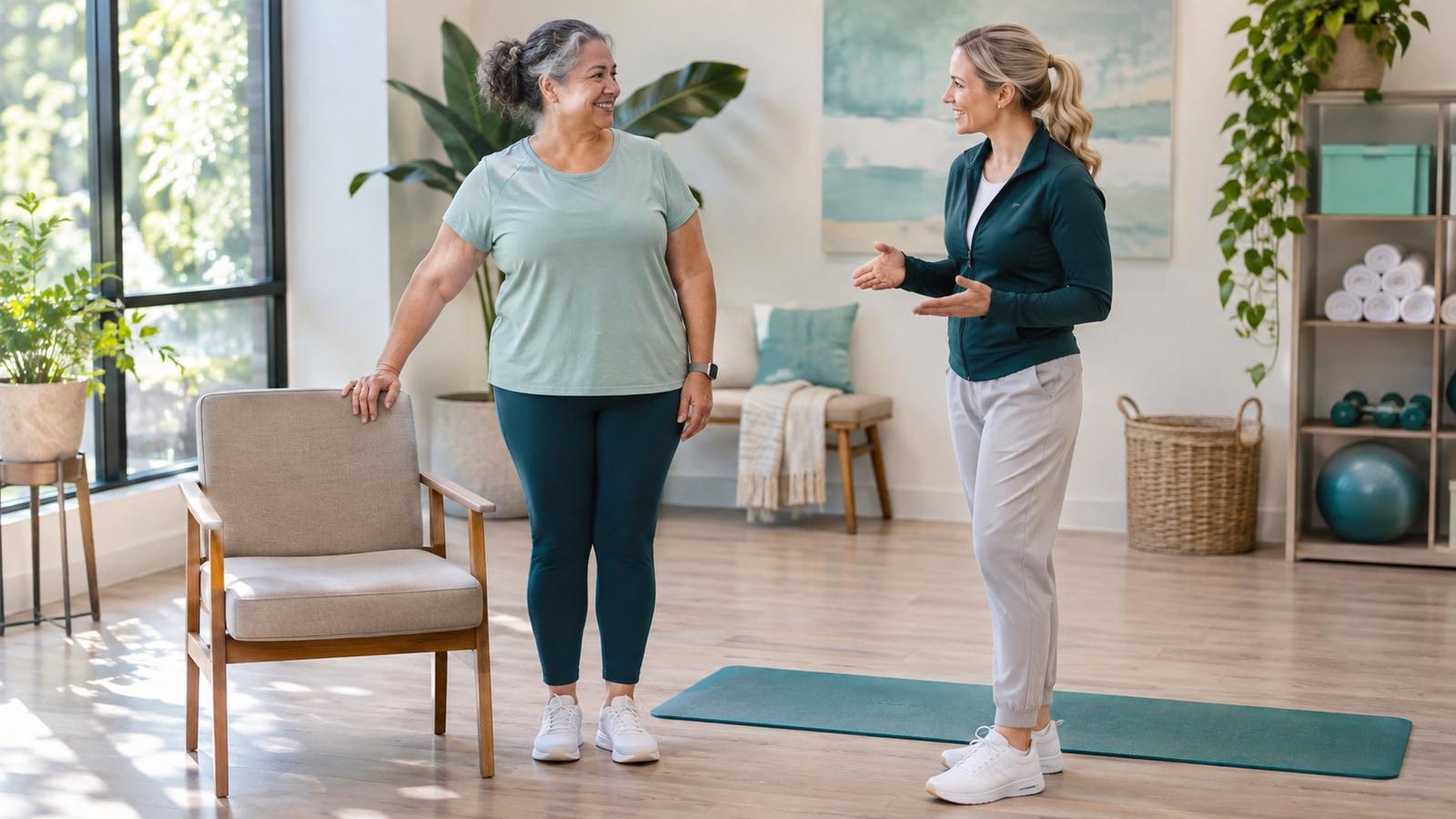
A lateral lunge is a side-to-side movement: you step to one side, bend the stepping leg and return to the middle. It can feel unfamiliar if most of your exercise involves moving forward. A stable support and a small step make it easier to learn.
The goal isn't to reach a deep position on day one. Start with a range you can control, and ask a qualified instructor or physical therapist to check the movement if you're unsure.
Make space beside a stable support
Choose a clear, nonslip floor near a counter or another surface that won't move. Stand facing the support, close enough to keep a hand on it while you step sideways. Make sure there is room to move in both directions without reaching around furniture.
Wear footwear that feels secure. If you use a chair for support, it must be stable and unable to roll or slide. A fixed counter is often easier to rely on. If the support moves when you put weight on it, change the setup before starting.
If you have knee, hip, ankle or balance concerns, recent surgery, or an activity restriction, ask your clinician or physical therapist whether this movement is appropriate. They can help you choose a range or another exercise that fits your needs.
Step and shift gently
Stand with your feet comfortably apart and both hands on the support if needed. Take a small step to one side, keeping both feet pointed generally forward. Once the stepping foot is planted, bend that knee and let your hips move back slightly as you shift toward that side.
Keep the movement shallow at first. The other leg may become straighter, but don't force either knee into a locked position. Your stepping knee should follow the direction of your foot rather than collapsing inward.
Press through the stepping foot to return to the middle. Breathe out during the return and move slowly enough to stay balanced. Pause, then try the other side if it feels comfortable.
Keep the step manageable
A very wide step can make it harder to keep your foot and knee aligned or return with control. If you feel stretched or unstable, shorten the step. You can practice shifting weight side to side with your feet already apart before adding a step, if a professional agrees that variation suits you.
You may feel your thighs and hips working. Sharp pain, dizziness, numbness or a feeling that you might fall means you should stop and seek guidance. Don't push deeper simply because a video shows someone else doing it.
Keep breathing throughout. If you hold your breath or pull hard on the support to complete the movement, use a smaller range or ask for another exercise. Support is there to help you balance, not to make you force a position.
Practice one side at a time
You can do a few controlled movements to one side, return to standing and rest before switching. Notice whether one direction feels different. A small difference in coordination isn't unusual, but persistent pain or a marked change is worth discussing with a professional.
Ask someone qualified to observe your first attempts. They can help you position the support, choose a comfortable step and check that you're returning without twisting or rushing.
There is no need to add dumbbells, a jump or a deep bend while learning. A simple, supported version can be enough practice for the day.
Choose an alternative if needed
If stepping sideways isn't comfortable or safe, ask about a different movement. A seated leg movement, supported sit-to-stand or another activity may fit your situation better. The right choice depends on your goals and any medical guidance you've received.
If you use a mobility aid, keep it as recommended and discuss how to set up the exercise with the professional who knows your needs. Don't remove support to match an online demonstration.
Build a routine with room to recover
A lateral lunge is one possible lower-body exercise, not a complete program. Combine it with other activities you enjoy and rest between sessions that challenge the same muscles. Ask a professional how many repetitions and how often make sense for you.
If you're managing a medicine-related appetite change or another symptom that affects energy, tell your care team. A shorter session or a rest day may be appropriate when you're not feeling well.
Finish where you started
When you're done, return to a stable standing position and take your time moving away from the support. Notice how you feel later in the day. Persistent discomfort or worsening symptoms are reasons to pause and ask for advice.
Start with a small side step, use a firm handhold and move at a pace you can control. A comfortable variation you can repeat is more useful than a deeper lunge that doesn't fit your body.