










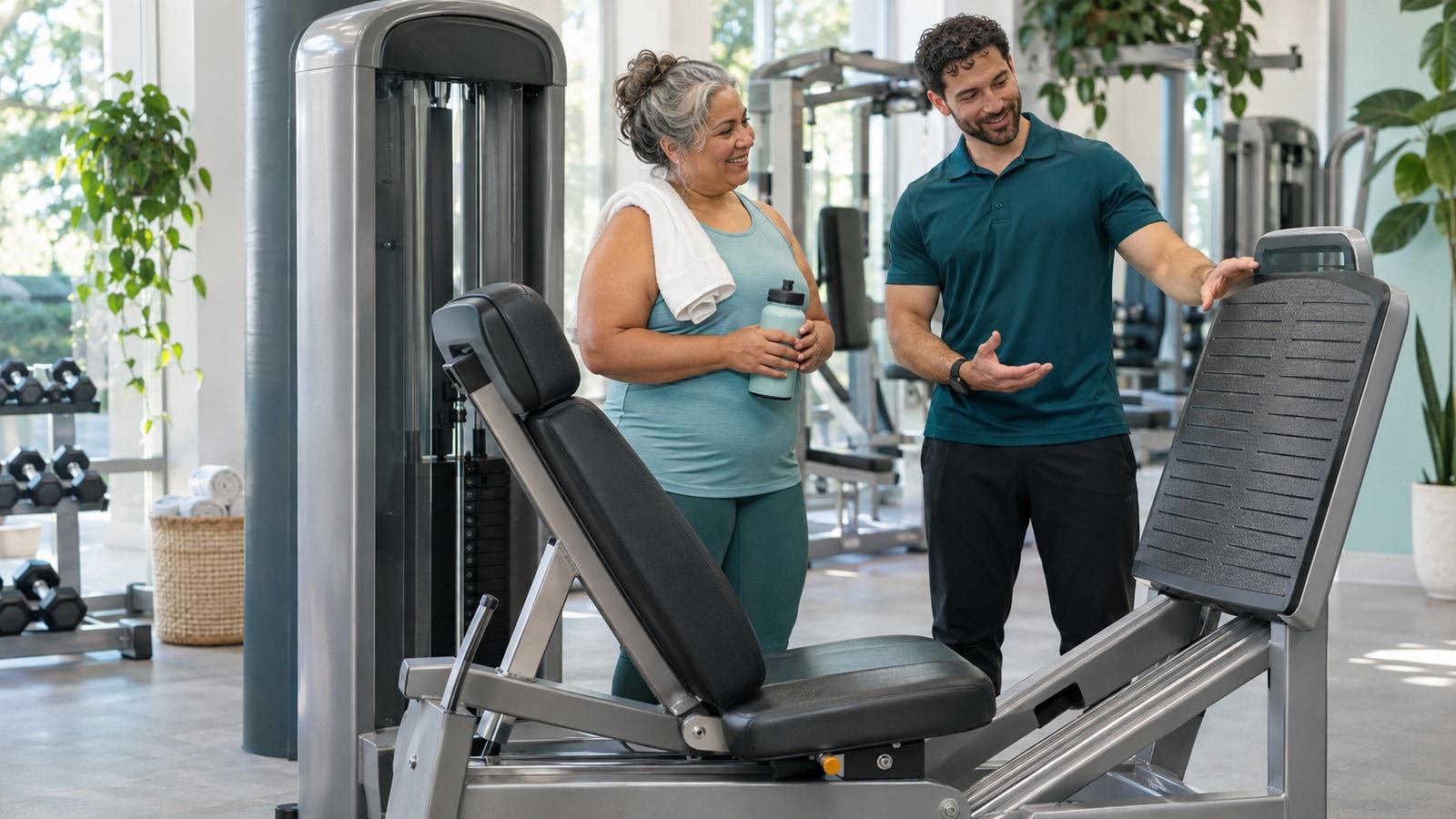
The leg-press machine can be a useful way to practice a lower-body movement with the support of a seat and backrest. It can also look complicated when you're unfamiliar with the seat adjustment, footplate and weight stack.
Machines aren't all identical. Before your first set, ask a qualified gym staff member or trainer to show you how the specific model adjusts, starts and stops. A few minutes of setup are more useful than choosing a heavy weight and hoping the machine fits.
Find a comfortable position
Sit with your back and hips supported against the pads. Ask how to adjust the seat so you can place both feet on the platform with your heels in contact and your knees bent comfortably. You shouldn't have to round your lower back or squeeze your thighs into your torso to reach the starting position.
Place your feet about shoulder-width apart as a starting point, then ask the instructor whether another position better fits your body and the machine. Keep your knees moving in a direction that feels natural over your feet rather than allowing them to collapse inward.
If you have an injury, joint restriction, recent surgery or uncertainty about the movement, talk with your clinician or physical therapist first. The suitable range may be different for you. Don't force a deep bend because the machine allows it.
Choose a manageable resistance
Ask how the weight selector works and make sure the pin is fully inserted, if the machine uses one. Start with a resistance that lets you move smoothly and remain in control. You can learn the path with very little resistance before deciding whether to change it.
The number on one machine may not feel the same as the number on another. Use it as a note for that particular setup, not a comparison with the person who used it before you. If the movement makes you hold your breath, lift your hips off the seat or move abruptly, reduce the resistance and ask for help.
Keep your hands on the handles if the machine has them, and follow the staff member's instructions for any safety stops or levers. Don't adjust the seat or weight while the platform is moving.
Press and return with control
From the comfortable starting position, press through your feet to move the platform away. Keep your heels in contact and your back supported. Breathe out as you press, and stop before locking your knees.
Pause briefly, then let the platform return slowly to the starting position while breathing normally. Stay within a range you can control without your hips lifting or your lower back rounding. A trainer can help you check the movement from the side and adjust the seat if needed.
You don't need to rush repetitions. A smooth press and return are more useful for learning the machine than bouncing the weight or moving as fast as possible. Stop the set when you can no longer keep the movement controlled.
Know what the movement should—and shouldn't—feel like
You may feel your thighs and hips working. Sharp pain, dizziness, numbness or a sensation that something is wrong is a reason to stop, not a cue to push through. Ask a professional to check the setup and seek medical advice for persistent or concerning symptoms.
Severe chest pain, significant difficulty breathing or fainting can require emergency care. Follow any personal exercise plan you've been given and contact your care team if the machine brings on new symptoms.
If the machine doesn't fit comfortably even after adjustment, choose another lower-body exercise with guidance. A supported chair rise or a different machine may be more appropriate for some people. There is no required piece of equipment for a useful strength routine.
Plan rest and progression
Your first visit can be a practice session. Note the seat setting, foot position and resistance that felt manageable, so you can recreate the setup next time. If the machine is shared, check the adjustments again before starting; the previous user may have changed them.
Give yourself recovery between strength sessions and ask a qualified professional how to build a balanced routine. Increase difficulty gradually when appropriate rather than changing resistance, range and volume all at once.
If you're also managing medication side effects or a reduced appetite, tell your care team how those affect activity. A strength plan should fit your energy, nutrition and health, not compete with them.
Ask the question at the machine
Try: “Can you show me how to adjust this seat and check my first few movements?” Point out any range that feels uncomfortable and ask how to stop safely. A good demonstration should leave you able to repeat the setup without guessing.
The leg press is one option among many. Take time to get supported, move deliberately and choose a resistance that lets you stay in control.