










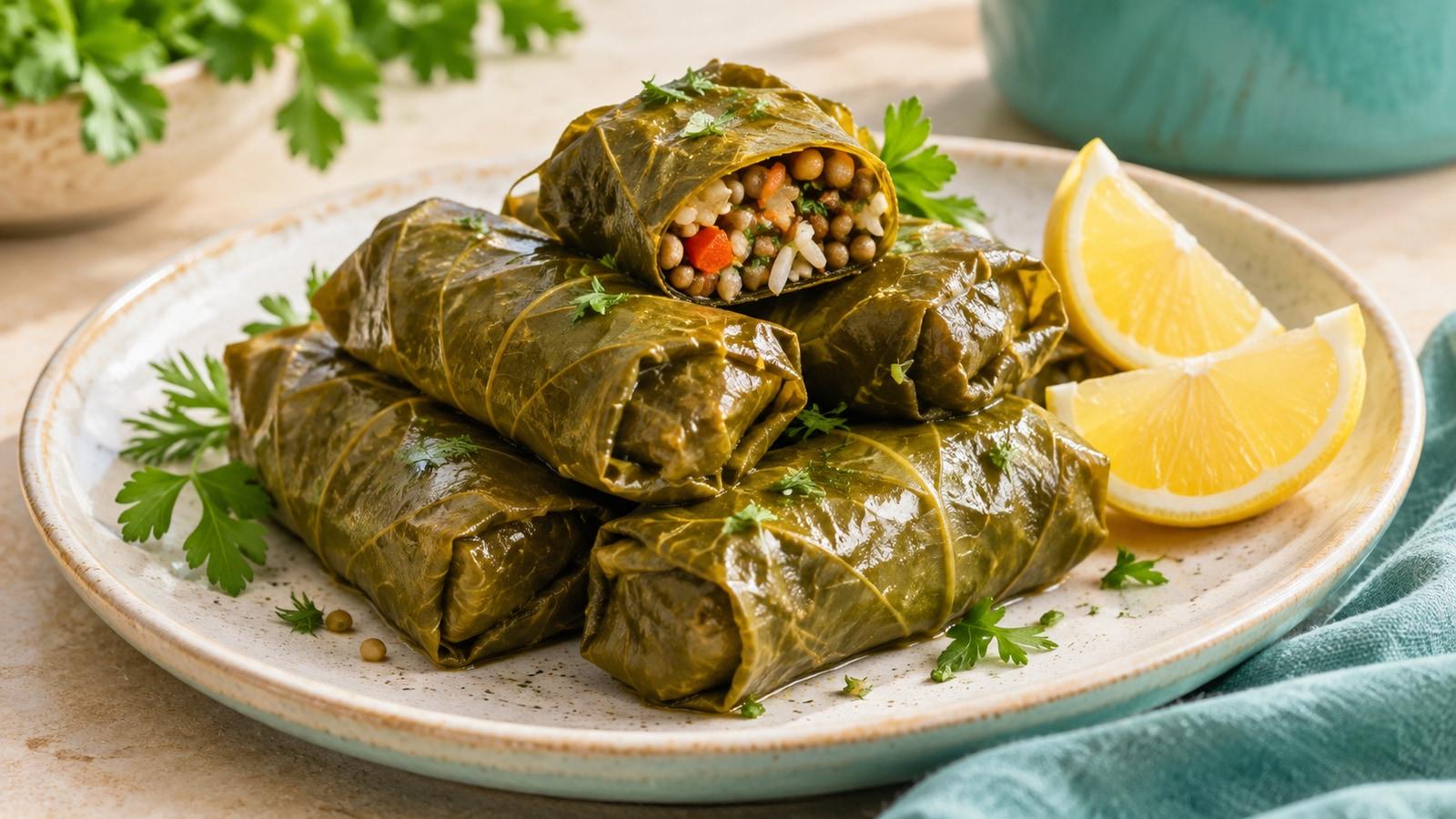
Stuffed grape leaves are enjoyed in many places, with fillings and serving traditions that vary by family and region. This home version uses cooked lentils, rice, vegetables, and herbs. The leaves are rolled into small parcels and warmed gently with lemon.
Rolling takes a little practice, so give yourself a relaxed stretch of time. The first few may look uneven. Once they’re tucked into the pot together, their exact shape matters much less.
Ingredients
Makes: about 20 small rolls, depending on leaf size
Prep: about 30 minutes
Cook: about 20 minutes, using cooked rice and lentils
- 20–24 jarred grape leaves, plus a few extras for lining the pot
- 1 cup cooked brown or green lentils
- 1 cup cooked rice
- ½ small onion, finely diced
- 1 small carrot, finely diced
- 1 tablespoon olive oil
- 2 tablespoons chopped parsley
- 1 tablespoon chopped mint, optional
- 2 tablespoons lemon juice, divided
- ½–1 cup water or lower-sodium broth
- Plain yogurt, optional for serving
If you want leftovers, start with freshly cooked rice and note the time it finishes cooking. The time spent filling and simmering the rolls counts toward the one-hour cooling window. Rice saved from an earlier meal needs different handling: it should have been refrigerated within one hour, kept cold for no more than 24 hours, and reheated only once. Eat those rolls immediately rather than saving them for another reheat. Rinse a grape leaf and taste a small piece before seasoning; the brine may already be salty.
Get the filling ready
- Wash your hands and rinse the carrot, parsley, and mint under running water. Drain the grape leaves, rinse them gently, and separate them without tearing if possible.
- Warm the oil in a skillet. Cook the onion and carrot until softened, adding a spoonful of water if needed. Transfer to a bowl.
- Add cooked lentils, rice, parsley, mint, and 1 tablespoon lemon juice. Mix gently. If the mixture seems dry, add a little water; it should hold together loosely without dripping.
- Line the bottom of a wide pot with a few spare or torn grape leaves. This gives the rolls a cushion as they heat.
Roll and warm
Lay one grape leaf flat on a clean surface, with the stem end nearest you. Trim a thick stem if needed. Place a small spoonful of filling just above the stem end, fold the lower edge over it, then fold in the sides and roll toward the tip.
Arrange the rolls seam-side down in the lined pot, close together. Add the remaining lemon juice and enough water or broth to come partway up the rolls. Set a heatproof plate over them if needed to keep them from unrolling.
Cover and simmer gently for about 20 minutes. Because the filling uses previously cooked rice and lentils, check that the center of a roll reaches 165°F. Add a little more liquid if the pot begins to dry. Rest briefly, then serve warm with yogurt if you like.
Make rolling easier
Leaf sizes differ, so there isn’t one perfect amount of filling. Start with a teaspoon or two for a small leaf and use more only if the leaf can close comfortably. Overfilling makes the seams harder to tuck in and leaves little room for the filling to settle.
If a leaf has a hole, overlap a small piece of another leaf over it before adding the filling. Torn leaves can also line the pot. Keep the rolls snug but not crushed; the goal is to stop them moving around while they warm.
Don’t throw away the remaining filling if you run out of leaves. Heat it thoroughly and serve it in a bowl with lemon and yogurt, or use it as a side for another meal.
Flavor and texture
Parsley gives the filling a fresh taste; mint adds a different, brighter note. Use one or both. Lemon can be strong, so start with the amount listed and pass extra wedges at the table. A little black pepper or cumin can be added if you enjoy it.
Brown and green lentils tend to hold their shape. Softer lentils can work too, but they may make the filling more compact. Lentils provide plant protein and fiber; rice gives the parcels a grain base. Mix the parsley through the filling before rolling and keep extra lemon for serving.
Jarred leaves vary in salt and thickness. Rinsing removes some brine, while the gentle simmer helps the leaves soften. If they’re still tough, continue cooking with a little more liquid and check again. Don’t let the pot boil dry.
Serving the parcels
A few rolls can be a side dish, or a larger portion can be served with a salad and another protein-rich food. Yogurt adds a cool contrast, but it contains milk, a common allergen. Choose a suitable alternative or skip it if needed.
Serve the rolls on a platter with lemon and herbs, or pack them individually for lunch. They’re delicate when hot, so lift them with a spoon or spatula rather than pulling them by one end.
Keep leftovers safely
For a fresh-rice batch, divide extra rolls among shallow containers and refrigerate them before the one-hour clock runs out. Eat the refrigerated rice within 24 hours. Reheat it only once, until the center reaches 165°F; check the middle of a large parcel, not just the surrounding liquid. A covered dish and a splash of water can keep the leaves from drying out.
If you prefer safely chilled rolls cold, keep them refrigerated until serving. Keep yogurt in a separate container, and follow the shorter rice-specific cooling and storage guidance even when other components have longer windows.
The rolling gets easier as you go. Choose a comfortable amount of filling, tuck in the sides, and let the pot hold the parcels together while they warm.