










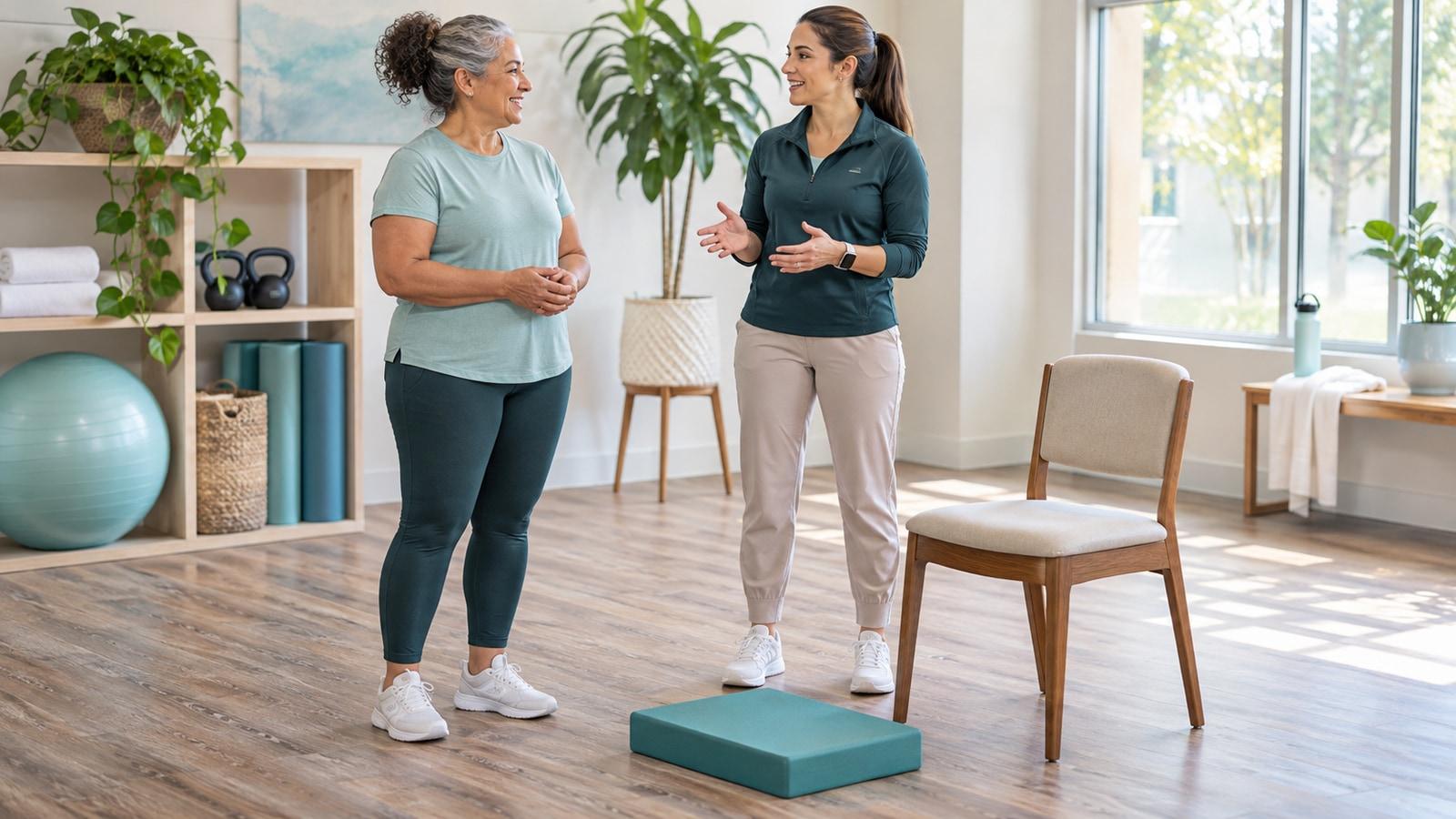
A foam balance pad makes the surface under your feet less stable. That can add a challenge to a balance exercise, but it doesn't mean everyone needs one—or that standing on a softer surface is the right first step.
If you're interested in trying a pad, start by asking a physical therapist or qualified instructor how it fits your goals and what support you need. A stable floor and a secure handhold may be a better place to begin. If you are building a movement routine as part of weight management, balance practice can be one part of it; a foam pad is optional, not a weight-loss treatment.
Why change the surface?
On a firm floor, your feet meet a predictable surface. A foam pad compresses and shifts slightly, so maintaining a steady position may feel different. Professionals sometimes use this change as one way to make a balance task more challenging.
That challenge isn't automatically better for every person. The exercise should relate to your abilities and goals, and it should be difficult enough to practice without creating an unreasonable risk of falling. A therapist can help decide whether the pad adds something useful for you.
If your goal is feeling steadier while walking to the mailbox or turning in the kitchen, describe that task. The professional can choose exercises and environmental changes that address the real situation rather than starting with equipment for its own sake.
Begin with support on a firm floor
Before introducing foam, practice the position your therapist recommends on a level, nonslip floor near a fixed counter or another stable support. Use both hands if needed. You should be able to enter and leave the position safely.
If you feel dizzy, have had a fall, notice new unsteadiness or aren't sure why your balance has changed, seek an assessment. A foam pad can't explain or treat every cause of balance difficulty.
People with a recent injury, surgery, foot or ankle problem, nerve condition or other health concern should follow their own care plan. Ask whether an unstable surface is appropriate before trying one at home.
Set up the pad carefully
Use a pad intended for exercise and place it on a dry, nonslip floor as the manufacturer directs. Position it beside a fixed counter or rail you can hold securely. Clear the area of loose rugs and objects, and have a stable place to sit nearby if you need a rest.
Ask a therapist how to step on and off. Don't assume a soft household cushion or a rolling chair is a safe substitute. If the pad slides, folds or feels too unstable, stop and change the setup with professional guidance.
A helper may be useful for some people. Discuss where they should stand and what kind of assistance you want. The aim is to make the practice safe and comfortable, not to remove every support as quickly as possible.
Check that you can reach the support both while standing on the pad and while stepping off it. If the arrangement requires you to stretch for the counter or turn awkwardly, ask a therapist to help you set up a safer position.
Keep the first task simple
With a professional's guidance, you might begin by standing with both feet on the pad while holding the counter. Notice the surface and breathe normally. Keep the task brief enough that you can remain controlled, then step off using the method you've practiced.
You don't need to close your eyes, stand on one leg or add a weight on the first attempt. Each change can make the task more challenging. Your therapist can decide whether any progression is appropriate and how to do it safely.
If the pad causes pain, dizziness, increasing unsteadiness or anxiety that prevents you from moving comfortably, stop. Return to a stable surface and ask for guidance. Don't continue just because the exercise looks easy when someone else does it.
Compare it with other options
Balance practice can involve many activities: standing with support, controlled steps, turning or movements adapted for a seated position. The best choice depends on what you want to do and what is safe for you.
A pad may be useful in one person's supervised program and unnecessary in another's. It doesn't replace strength work, accessible surroundings or an evaluation of falls. If you use a mobility aid, keep using it as recommended and discuss how the exercise fits with your usual support.
Ask about progression and follow-up
Before practicing alone, ask: “What task should I do, what should I hold, and when should I stop? How will we decide whether to change it?” Write the instructions down or ask for them in an accessible format.
Keep track of how the activity feels during and after practice. New or worsening dizziness, falls or persistent discomfort should be discussed with your care team. A safe plan includes a way to pause and reassess.
Foam can add variety, but it's only a tool. Start with a secure environment and a task that fits your ability; the pad is optional.