










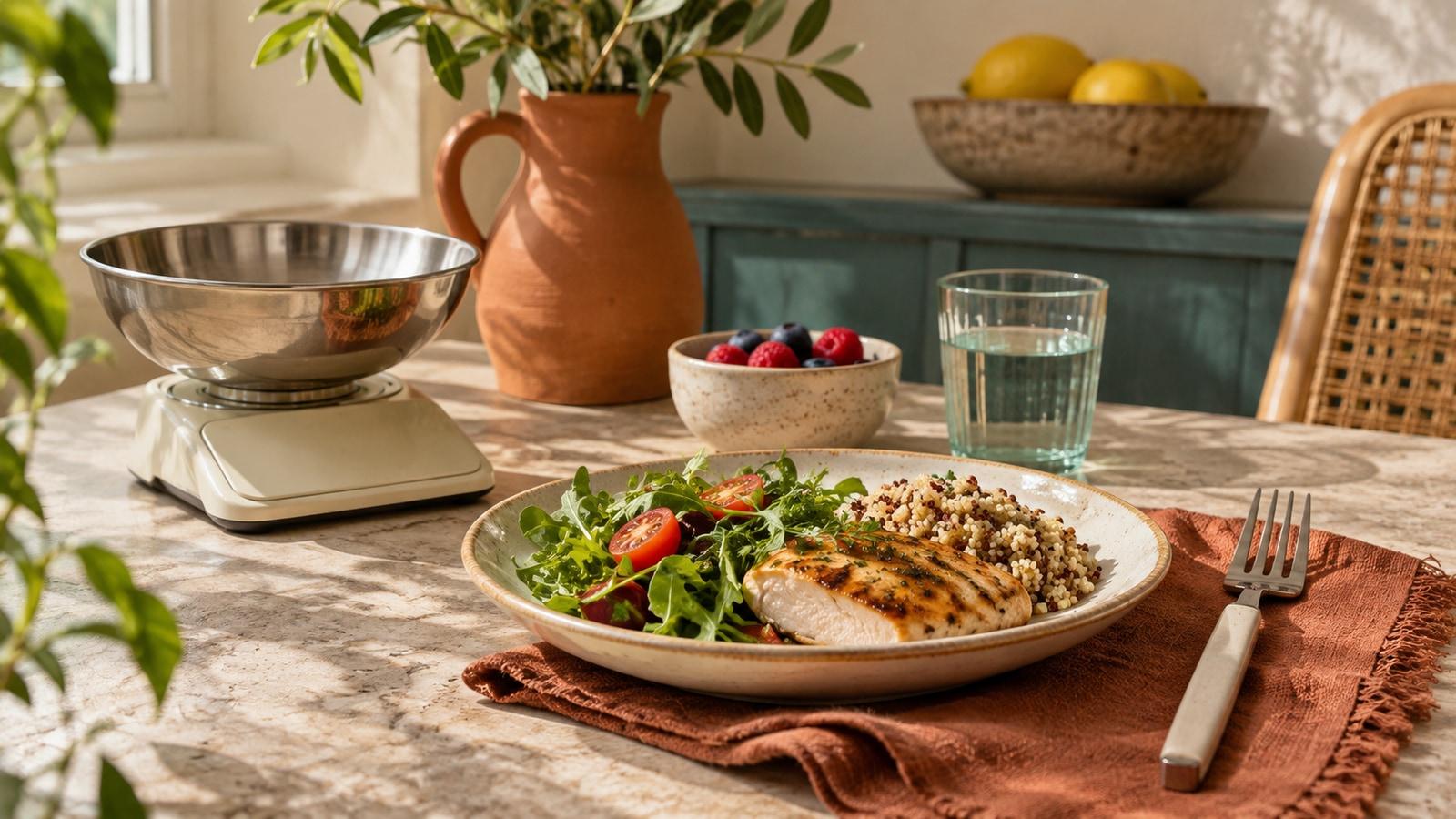
Calories show up on cereal boxes, restaurant menus, and exercise watches. They can start to look like a judgment about whether a food is “good” or “bad.” A calorie is much simpler than that: it's a unit used to describe energy.
Your body needs energy all day, including while you're sleeping, digesting food, thinking, and moving. Food and drinks provide energy along with other things your body needs. The number on a label describes one part of the food, not its entire value.
The number on a food label
When a food label says “Calories,” it's describing the estimated energy in a serving. The scientific unit behind that familiar number is a kilocalorie, sometimes written as kcal. In everyday nutrition conversations, people usually just say “calorie.”
That means a package labeled 150 Calories per serving provides an estimated 150 kilocalories per listed serving. It doesn't automatically mean the whole package contains 150. Look for the serving size and the number of servings in the container.
For example, if a bottle lists 150 Calories per serving and contains two servings, the label amounts to 300 Calories for the full bottle. If you drink half, the per-serving figure may be the more useful comparison. Some labels show both amounts so you don't have to do the multiplication.
The serving size is a reference amount on the label, not an instruction that you must eat exactly that much. Your portion is what you actually choose to have.
Where does the energy come from?
Carbohydrate, fat, protein, and alcohol can all contribute energy. As a rough guide used in food-energy calculations, a gram of carbohydrate or protein provides about 4 Calories, a gram of fat about 9, and a gram of alcohol about 7. Foods contain different combinations, so the total depends on the ingredients and amount.
You don't need to calculate your lunch from those factors. Food-energy estimates can use more specific values, and label rounding or the way components are measured can make a quick calculation differ from the number printed on the package.
The higher number for fat doesn't make fat something to avoid. Fat has roles in the body and can add flavor and satisfaction to a meal. Protein and carbohydrate have roles too. A food's calorie count doesn't tell you everything about its nutrients, taste, cost, or how it fits with the rest of what you eat.
Why labels are estimates
A packaged food isn't identical in every microscopic detail. Ingredients can vary, serving sizes are practical measures, and the energy value shown is calculated or otherwise estimated from information about the product. For a home-cooked meal, the amount of oil, the ingredients, and how many portions you make can all change the estimate.
Consider a pot of bean soup shared between three people. If the portions aren't equal, dividing the whole pot's estimated calories by three gives a rough average, not an exact measurement of each bowl. That doesn't make the estimate useless. It just helps to know what the number can reasonably tell you.
The same caution applies to a restaurant meal. A posted amount can help you compare choices, but a variation in serving size or preparation may mean your plate differs from the listed estimate. You don't have to treat an estimate as a laboratory result to make a useful decision.
Calories used are estimates, too
Your body uses energy for much more than a workout. Breathing, maintaining body temperature, and other everyday functions all require it. How much a person uses varies with factors such as body size, age, activity, and metabolism.
An exercise machine or watch may display an estimated number of calories used. It can't measure every factor that affects your body in real time. Treat the display as a rough reference rather than a precise bill that tells you how much you have “earned” to eat.
That distinction matters when people compare themselves. A target that suits one person may not suit someone else, even if they take the same medication or follow a similar exercise routine.
Do you need to count them?
Not necessarily. Some people find that looking at labels or recording food helps them understand portions and patterns. Others find detailed tracking stressful or unhelpful. A dietitian or healthcare professional can help you choose an approach that fits your health, preferences, and history.
If you're taking a GLP-1 and your appetite has become much smaller, focus on whether you're able to eat and drink in a way that supports you. Bring up persistent nausea, weakness, or difficulty eating enough. A lower calorie number isn't automatically a better outcome if the routine leaves you feeling unwell.
The next time you see a calorie figure, read it as information about estimated energy in a stated amount. Then consider the rest of the picture: what the food offers, whether you enjoy it, and how it fits into your day.