










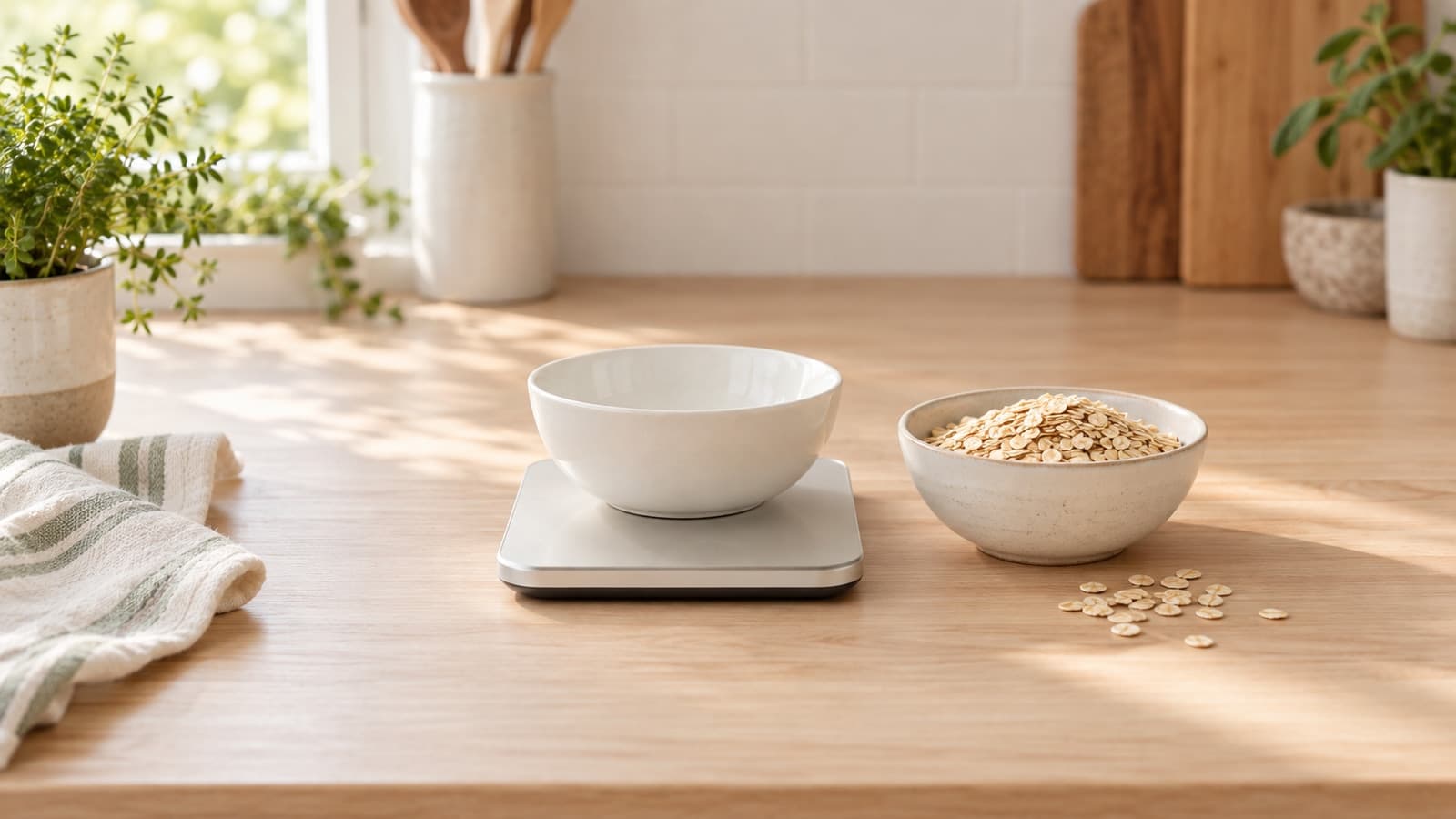
A recipe asks for grams, but your measuring cup is in the dishwasher. That’s a perfectly ordinary reason to reach for a kitchen scale. You might also use one briefly to understand a label or divide a batch of food.
A kitchen scale is a tool, not a requirement. If it makes meals easier, use it for that job. If it makes food feel more complicated, there are other ways to cook and eat.
A quick tour of the buttons
Place the scale on a stable counter and follow its instructions to turn it on. Check the units: grams and ounces describe weight, while cups and fluid ounces describe volume. They aren’t interchangeable for every ingredient because different foods can weigh different amounts in the same volume.
Many digital scales have a “tare” or zero button. With an empty bowl on the scale, that function can reset the display so you can measure what you add rather than the bowl as well. Check your model’s directions and its maximum capacity. Keep liquids and food away from parts the manufacturer says shouldn’t get wet.
For a recipe with several ingredients, you can add one, note its weight, and use tare again before adding the next. Take your time with that button: once the display returns to zero, it shows the next addition rather than the total already in the bowl.
When the scale can be useful
For baking or a recipe written in grams, a scale can save you from converting an ingredient into a volume measure. It can also help divide a prepared batch. For an easy math example, a 120-gram batch split evenly among three containers would be 40 grams per container. That is a calculation, not a portion recommendation.
If you’re curious about a packaged food, compare its label serving information with what you actually use. Labels commonly show a household measure and a gram amount. The listed serving is a reference for the nutrition information, not an instruction about how much you personally should eat.
You can also use familiar bowls, measuring cups or your usual serving utensils. You don’t have to weigh a food to make a meal balanced or enjoyable.
When it may be extra work
If measuring everything slows you down, makes eating with other people difficult or leaves you preoccupied with numbers, consider putting the scale away. A short experiment can answer a specific cooking question without becoming a rule for the rest of the week.
People with a history of an eating disorder or distress around food tracking may want to discuss measurement with their clinician or dietitian before using it. You can ask for practical meal support that doesn’t involve a scale or calorie counting.
Keep food handling simple
Use a clean bowl or plate on the scale rather than placing food on a surface that is hard to clean. Wash your hands, utensils and work surfaces as appropriate for the ingredients you’re preparing. A weight reading doesn’t tell you whether food is cooked or safe to eat; follow the relevant cooking and storage directions.
If you’re measuring ingredients for a recipe, notice whether it asks for them before or after cooking. A cooked food may weigh differently from the ingredient you started with, so the two measurements may not describe the same thing.
Ask a better question than “Should I weigh everything?”
Try “Would this help me make this recipe?” or “What does this label mean?” Once you have the answer, you can choose whether the tool earns a place on your counter. If you’re unsure how much food meets your needs while taking a GLP-1, a dietitian can help you work through the question in the context of your appetite and health.
Our food label guide offers another way to understand the package. The best kitchen routine is one you can actually live with.