










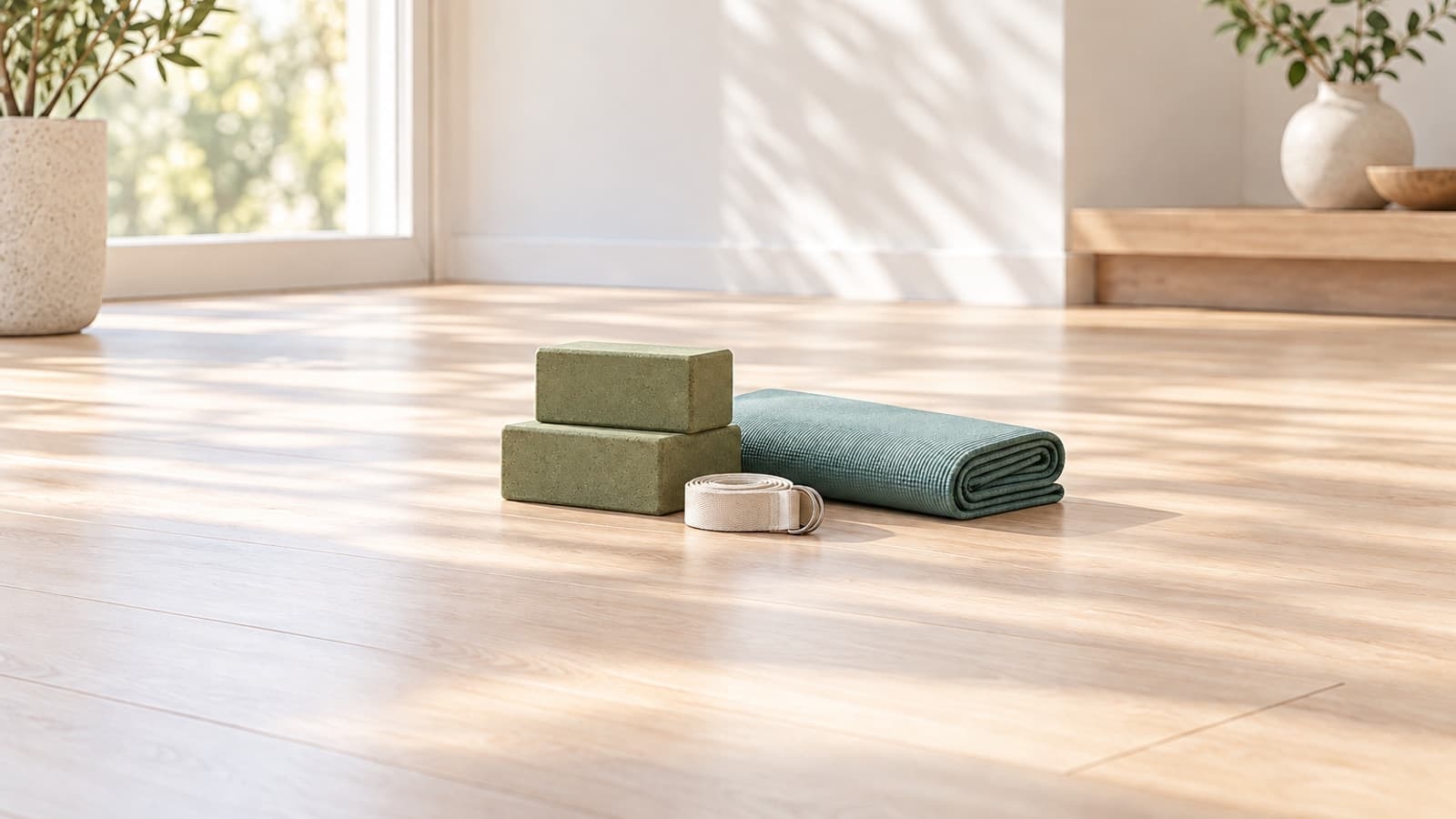
You arrive at a yoga class and see blocks, straps, folded blankets and chairs stacked along the wall. Are they only for people who can’t do the “real” version?
Not at all. A prop brings the position closer to you. It can give you a place to rest, shorten a reach or offer another way to participate. The useful choice depends on your body, the movement and what feels steady that day.
Start by telling the instructor what you need
Before class, mention anything that affects your movement: perhaps a sensitive knee, difficulty getting onto the floor or a shoulder that doesn’t like reaching overhead. You can speak privately and share only what you’re comfortable sharing. Ask, “Could you show me a version that works from a chair?” or “Where should I put the block for this position?”
A qualified instructor can show you how to arrange a prop for the particular pose. If you’ve had an injury or procedure, or have been given movement restrictions, check with your healthcare professional as well. Some movements may need to be changed or skipped rather than supported with another piece of equipment.
You don’t have to keep up with every transition. Pause the video, take a break or stay with an option you know is appropriate. A pose that looks effortless from across the room isn’t a target you have to reach.
Blocks can bring the floor closer
A block may provide a higher surface for a hand in a supported position when the floor feels too far away. Different faces offer different heights. Ask an instructor which side should be against the floor and where to place it for the movement you’re doing.
Check that the block is on a level, non-slip surface and feels stable before putting weight on it. A stack of wobbly books or a chair on wheels is not a dependable substitute. If the position still causes pain or makes you feel unsteady, stop and ask for another option.
Blocks are not there to force your hand lower every week. The height that lets you breathe and remain in control may be the right choice for as long as you use that movement.
A strap can make a reach less demanding
In some seated or lying positions, a strap gives your hands something to hold when a foot is hard to reach. It shouldn’t be used to pull a joint farther than it comfortably wants to go. Ask how to hold it and how to release it easily; keep it away from your neck.
If holding a strap bothers your hands or shoulders, mention that too. A different prop or a different activity may work better. The aim is a comfortable option, not a deeper stretch at any cost.
Chairs, cushions and blankets have jobs too
A sturdy chair can offer a seated version of a practice or support for certain standing movements when an instructor recommends it. A folded blanket or bolster may make a resting position more comfortable. Ask how to set them up, especially if getting up from the floor is difficult.
Check that a chair is stable and will not slide. Leave space around it and keep the floor clear. A photograph of a setup is not proof it’s safe for your room, so test the actual equipment with your instructor before relying on it.
Make the class yours
You can ask about props before signing up or bring your own if the studio allows it. You might use a chair throughout one class and a block in another. Both are ordinary ways to participate.
If GLP-1 symptoms are leaving you dizzy or making it hard to drink, discuss activity with your care team. Our balance and mobility guide has more ideas for choosing stable, manageable movement. The best setup is the one that helps you move comfortably and stay in control.