










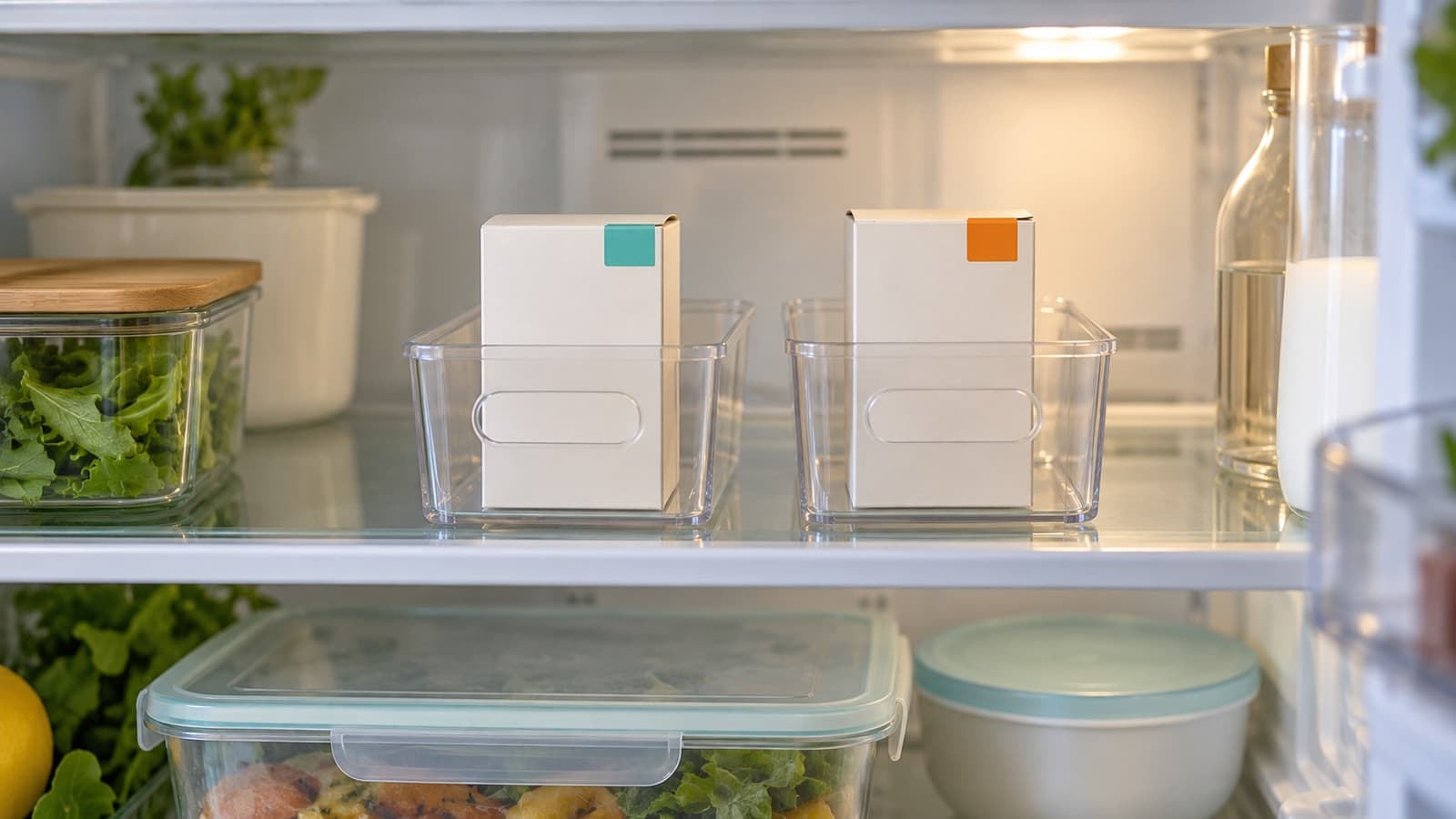
Two similar cartons end up beside the leftovers. One belongs to you, another to your partner, and a refill has just arrived in different packaging. Nobody intends to mix them up, but the fridge could use a clearer system.
Separate spaces can make things easier to find. They still need to preserve the medicine's actual storage conditions and labels. Choose the storage conditions first and the organizer second.
Read each product's directions before choosing a shelf
Start with the exact medicine and presentation supplied by the pharmacy. An unopened carton, an in-use pen and a vial may have different instructions. Don't apply one person's room-temperature allowance or in-use deadline to another person's prescription.
Check what must stay refrigerated, how it should be protected from light and whether first use starts a separate clock. Ask the dispensing pharmacy to clarify anything missing or unclear, especially for a pharmacy-prepared product.
Some injectable GLP-1 products must stay in their original carton to protect them from light. An attractive tray shouldn't replace packaging the product needs. Keep the instructions available after the shipping materials are gone.
Give each person a separate home base
One small bin per person can be an organizational starting point if the pharmacy confirms it works with the storage requirements. Put the person's name on the bin and keep every original medicine label readable. If a locked container is needed for child safety, ask which option will preserve the required temperature.
Color can be a second cue, but avoid making it the only way to tell prescriptions apart. Carton designs, strengths and suppliers can change. The useful check is still the person, product and current directions on the actual prescription.
If someone has more than one item, keep them separated inside their space rather than mixing loose pens or vials. Leave enough room to pick up one carton and read it without pulling out everybody's supplies.
Protect the temperature as well as the labels
Don't place medicine against a freezing surface or refrigerator cooling element. Follow its specific temperature instructions and ask the pharmacist about a suitable location and thermometer if you aren't sure how your fridge behaves.
A bin doesn't turn an unsuitable shelf into a safe one. It also isn't permission to pack the area tightly, add ice packs or move the cartons into the freezer to make more room.
Keep medicines out of children's reach. A shelf that is convenient for an adult may still be accessible to a child when the door is open. Discuss a workable storage arrangement for the actual household rather than relying only on a reminder to leave things alone.
Agree on what happens after a delivery
Choose who will put a refrigerated delivery away promptly under its instructions. Tell other household members where it belongs so an unfamiliar box doesn't sit on the counter while someone waits for you to get home.
When a refill arrives, compare the label with the current prescription before adding it to the bin. Keep changed or discontinued supplies clearly separate while asking the pharmacy how to handle them. Don't leave an older strength at the front simply because it arrived first.
Record any required opening or discard date where it is easy to find without covering the pharmacy label. Returning a product to the refrigerator doesn't automatically restart its permitted time outside it or extend an in-use deadline. Use the actual product directions.
Keep sharing the space separate from sharing treatment
Take out only your own prescription and read its label each time. Similar packaging or a matching ingredient doesn't make another person's supply a substitute. Don't share a prescription pen, including a multi-dose pen with a changed needle.
If the wrong medicine was used, seek immediate pharmacist or medical advice rather than waiting to see how you feel. If a carton is missing its identifying label or the storage history is uncertain, pause before using it and have the pharmacy help resolve the question.
After a power outage or possible freezing, report the product and what you know about the temperature and duration. Don't judge usability by appearance alone. For the separate question of taking medicine away from home, see storing and traveling with GLP-1 medication.