










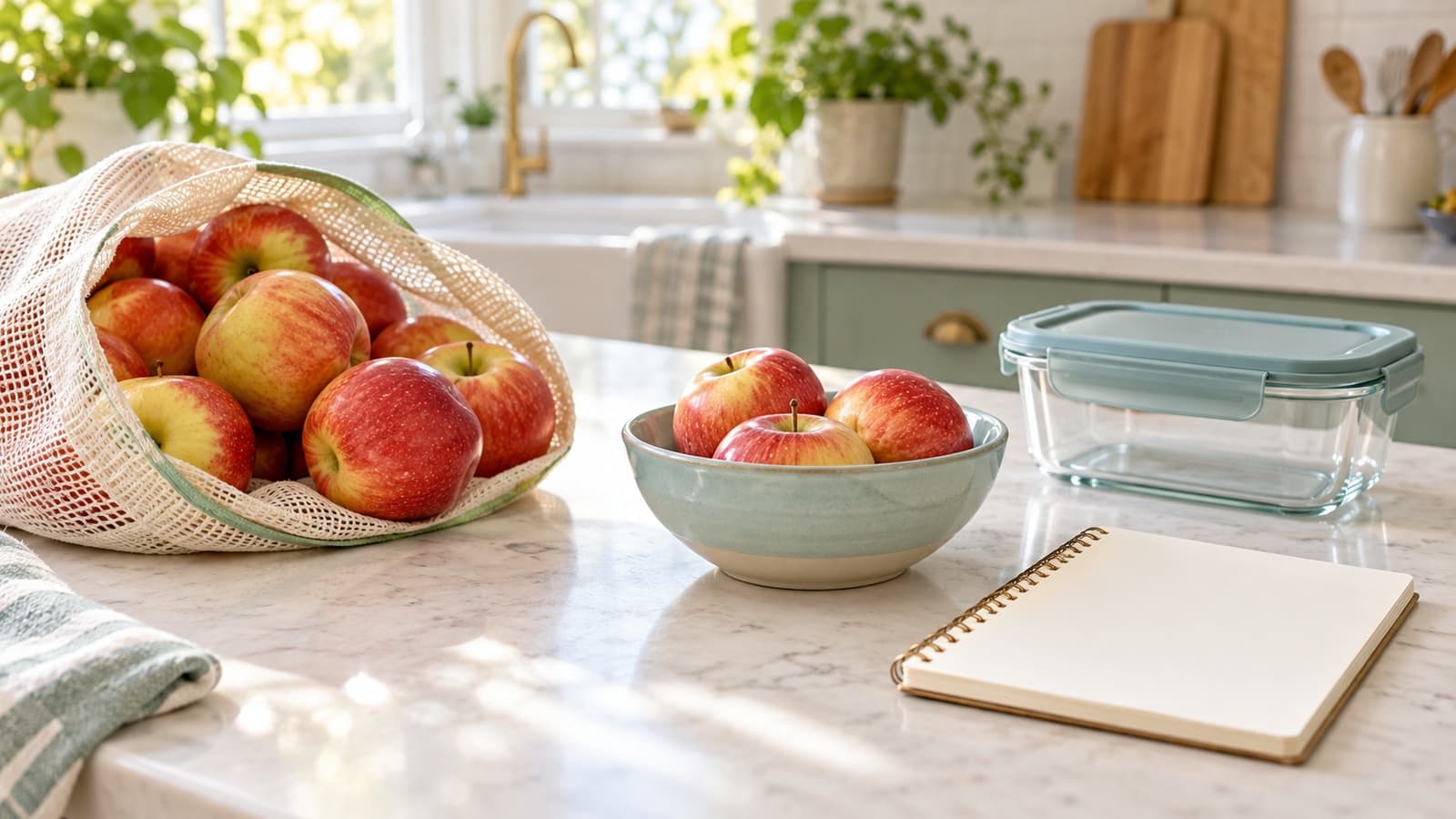
The bigger bag has the better price per apple. You put it in the cart, then realize later that three apples went soft before anyone ate them.
That doesn’t make buying in bulk a mistake. It just means the shelf price wasn’t the whole calculation. If your appetite has changed on a GLP-1, or you’re shopping for one, the amount you can use matters as much as the amount you can buy.
Try the math with a small example
Imagine two choices: a bag of six apples costs $6, while three individual apples cost $4.50. These numbers are made up for the example; prices and apple sizes vary.
The bag costs $1 per apple, and the individual apples cost $1.50 each. If you eat all six from the bag, the larger purchase saves money per apple. But if you eat only three and throw the rest away, you spent $6 for three apples you used: $2 apiece. The smaller purchase cost $1.50 for each apple eaten.
In this example, using four apples from the bag makes the cost per apple used $1.50, the same as the smaller purchase. Use five or six and the bag has the lower cost per apple used. Count what you expect to use, not just what you bring home.
That’s a comparison tool, not a reason to finish food that has spoiled or eat past comfort. The unused food is already paid for; forcing it down doesn’t make the purchase a better fit.
Give the extra a real plan
Before buying a larger package, ask where the extra will go. Can you share it with someone? Will you use it in two different meals? Is it a food that can be frozen safely in portions you’ll recognize and actually want later?
For instance, a large loaf might work if you separate and freeze slices soon after buying it, then take out only what you need. If your freezer is full or you dislike the thawed texture, a smaller loaf may be more practical.
Some items are easier to buy ahead than others. A bag of frozen vegetables can be portioned as needed, while a large tub of a perishable food may demand a more immediate plan. Storage space matters too. A bargain that doesn’t fit in your refrigerator or freezer may create a problem before it saves money.
If you freeze a suitable food, label the package and date it. Follow food-specific storage guidance and refrigerate perishable foods promptly. Don’t freeze food that has already been left out too long in the hope that the freezer will make it safe.
Think beyond the unit price
Compare the amount you’ll pay at checkout, too. A large package can be cheaper per ounce and still take more of this week’s budget. Buying a smaller amount may leave room for foods you need sooner.
Convenience has value. A smaller package, pre-portioned food or a second short shopping trip may cost more per unit but fit your schedule better. On the other hand, a large bag of a shelf-stable staple you already use every week may be an easy win.
If your appetite varies, plan a few flexible meals rather than buying for an ideal week. Use a small amount of chicken in a wrap one day and a bowl the next, or choose a grain that can accompany different foods. Keep another eating opportunity available if a first meal is small.
Do a gentle check next week
Look at one food that went unused and ask what happened. Perhaps the package was too large, you were away more than expected, or you simply didn’t like it. None of those answers requires guilt. They’re useful clues for the next cart.
Our guide to eating well on a budget has more ways to plan around the week you actually have. Buy the larger size when you have a workable use for it; the smaller one is a perfectly sensible choice when you don’t.